Financial Aid Application Sparks Frustration Among OFWs in UAE
Many Overseas Filipino Workers (OFWs) in the United Arab Emirates (UAE) have expressed concern over the application process for financial aid from the Department of Migrant Workers (DMW), intended for those affected by the crisis in the Middle East. On the day the online registration opened, many Filipinos in Dubai and the Northern Emirates were surprised and disappointed when the application link closed almost immediately, despite guidelines stating it would remain open until midnight.
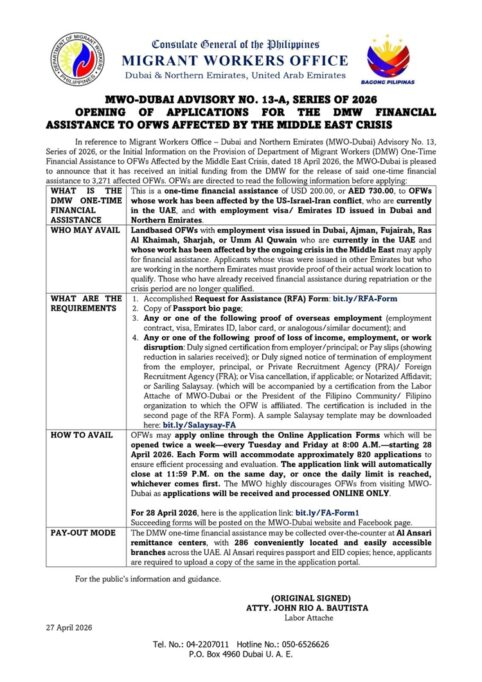
The DMW, the government agency responsible for the welfare of OFWs, had earlier announced a one-time financial aid of $200 (around PHP 12,000) for qualified land-based workers in the UAE whose jobs were affected. Applicants were required to submit documents such as a Request for Assistance form, valid IDs, passport copies, employment certificates, and an affidavit. Applications were to be submitted online through the Migrant Workers Office (MWO) in Dubai and the Northern Emirates, with approved funds to be sent via money transfer.

An update posted on April 27 clarified that applications would be accepted twice a week, every Tuesday and Wednesday starting at 8:00 a.m., and would close either at 11:59 p.m. or once the daily limit was reached. It was later stated that only 820 slots were available per day to ensure proper review of applications.

On April 28, the first day of application, the system reportedly closed within just 20 minutes. Many OFWs questioned how the slots were filled so quickly, noting that some were still completing their documents when the application stopped accepting entries. Concerns were also raised about possible system issues and whether all applicants were properly reviewed.
However, some OFWs defended the process, saying the instructions were clear and that early preparation was important. They shared that having documents ready before the opening time increased the chances of securing a slot. With an estimated 700,000 OFWs in the UAE, including about 450,000 in Dubai, the limited slots highlight the high demand and the challenge of distributing aid fairly.